

Correct diagnosis is at the heart of controlling coccidiosis in poultry.
The disease’s signs vary depending on the species of Eimeria involved and the dose of infective oocysts ingested. Severe infections impair nutrient absorption, slow growth, increase feed conversion ratio, cause diarrhoea or even death.
Identification of the infecting species relies on locating intestinal lesions in characteristic anatomical sites. Differentiating coccidiosis from other diseases such as necrotic enteritis, Salmonella or mycotoxicoses is important.
Good management includes monitoring, timely diagnosis, targeted treatment or vaccination, and appropriate hygiene and litter management to break the parasite lifecycle and prevent recurrent outbreaks.
Key points
- Symptoms and severity depend on Eimeria species and infection load, with heavy infections causing poor growth, diarrhoea or death.
- Accurate diagnosis requires lesion examination with attention to the specific intestinal sites of each Eimeria species.
- Effective control combines diagnosis with hygiene, litter management, treatment or vaccination to disrupt the parasite lifecycle.
Clinical symptoms of Coccidiosis can depend on the infecting species and the number of infective oocysts ingested. In heavy infections, impaired nutrient absorption increased feed conversion ratios, decreased growth rates, poor skin pigmentation, chilling symptoms, diarrhea, prostration, and death may be observed in both chickens and turkeys.
Identification of infecting Eimeria species can also be made as the Coccidian preferentially infect specific areas of the intestine.
Site of Infection for Chickens
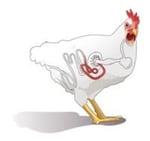
E. acervulina
Duodenum, reaches the jejunum in heavy infections. Lesions do not extend beyond Meckel's diverticulum.
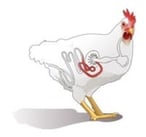 E. brunetti
Ileum and large intestine. Extends along the intestine during schizogony. In heavy infections it extends back up into the ceca.
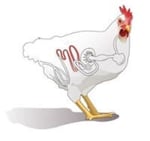
E. maxima
Jejunum and ileum. Lesion examination is carried out in the surrounding area of Meckel's diverticulum.
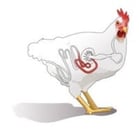
E. necatrix
Schizogony in jejunum and ileum; gamogony in the ceca.
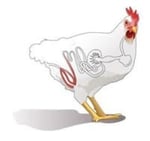
E. tenella
Ceca (sometimes terminal ileum and large intestine); may develop differently in the two ceca.
Site of Infection for Turkeys
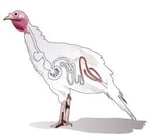
E. adenoides
Ceca and terminal ileum.
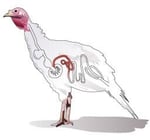
E. meleagrimitis
Duodenum and jejunum (at the top of the villi).
Differential Diagnosis
Differentiation from non-coccidial diseases is crucial, and common differential diagnoses include:
Chickens
- Blackhead (caecum)
- Salmonella (caecum)
- Necrotic enteritis (Clostridium perfringens) (small intestine/ileum)
- Capillarisis (small intestine)
- Salt poisoning (small intestine)
- Mycotoxicoses (small intestine)
- Cannibalism (blood in feces)
Turkeys
- Salmonella
- Blackhead (caecum)
- Necrotic enteritis (Clostridium perfringes)
- Hemorrhagic enteritis