

The Impact of broiler Gender Sorting
Sustainability has become a strategic pillar for the poultry industry, driven by the need to reduce environmental impact and ensure profitability. This concept is based on three pillars: environmental, social, and economic. Achieving balance requires adopting practices that optimize resources and minimize emissions.
Prefer to download this article? Click the button below to download it as a PDF!
Climate Challenge and Poultry Farming
Limiting climate change is part of numerous national regulations worldwide. For instance, European Union countries set as a target to reach by 2050 climate neutrality: 2050 long-term strategy - Climate Action - European Commission.
This target relies on achieving net zero greenhouse gas emissions by investing in green technologies and protecting the natural environment. But the main contributor to this plan will be by cutting the emissions in industry, transport sectors for instance. Indeed, greenhouse gas (GHG) emissions, especially methane and nitrous oxide, which have a much higher warming potential than CO ₂, play a key role in global climate change.
Livestock production can play a role in this plan to reduce greenhouse gas emissions related to feed production, energy or effluent management for instance. Among different species, poultry production has the lowest gas emissions with 612 million tonnes of CO₂ eq per year. In details, the feed production is one of the large contributors of broiler production emissions.
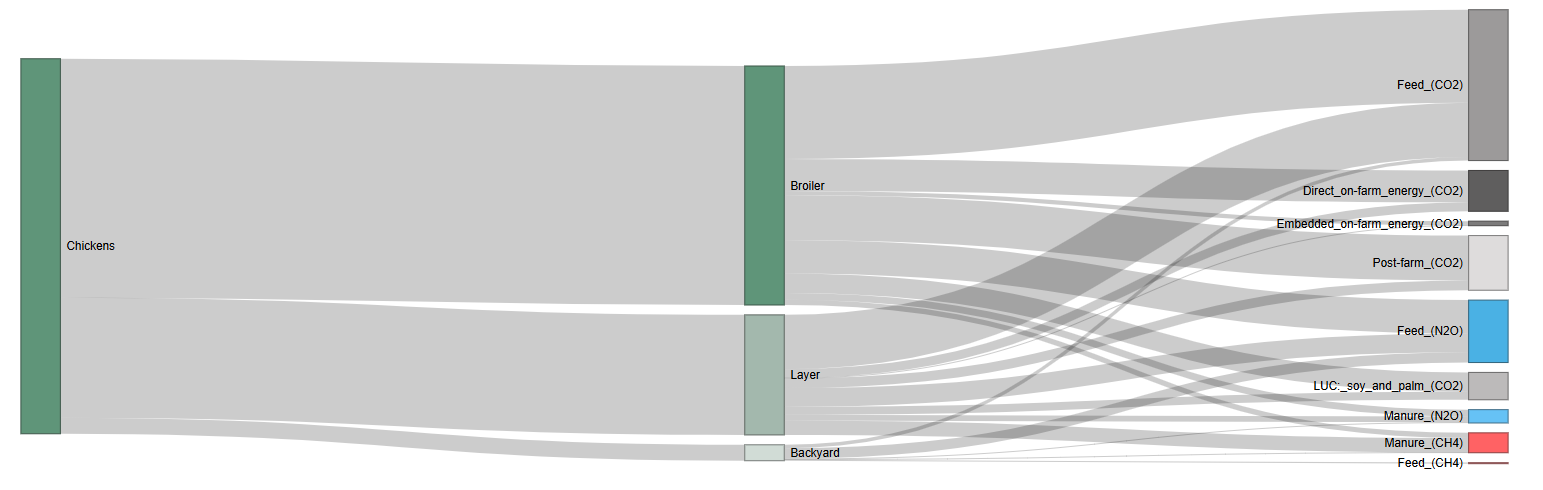 Source: foodandagricultureorganization.shinyapps.io/GLEAMV3_Public/)
How can broiler gender sorting contribute
Practically, by separating male and female day-old chicks at hatch, broiler gender sorting allows:
- To optimize feed nutrition with lower FCR
- To reduce mortality, especially on heavy male birds
- To improve carcass uniformity.
From a sustainability standpoint, broiler gender sorting improvements lead to:
- Environmental positive impact by reducing mortality and feed optimization, less resources are required reducing the carbon footprint.
- Social positive impact: with the mortality reduction and carcass uniformity improvement, more meat is available per flocks giving the opportunity to feed more people.
- Economical positive impact: by reducing the quantity of feed required per bird for the same bodyweight, the producer margin is improved
Tools to Measure Impact
Ceva has developed the Sustainability Calculator, a tool that quantifies the benefits of broiler gender sorting in all 3 sustainability pillars: environmental, social, and economic. It allows producers to simulate scenarios and make data-driven decisions aligned with global climate goals.
For instance, comparing the performances of 2 different flocks:
Flock 1 – Gender sorted: Male; 20,000 birds; 2.89 kg; harvested at 41 days
Flock 2 – As- Hatched: 20,000 birds; 2.65 kg; harvested at 41 days
By inputting the 2 flocks' performances into Ceva Sustainability calculator, the estimated gender sorting benefits for the 3 sustainability pillars are:
- Environment benefits: 5 tons of CO₂ emissions are saved
- Social benefits: +2162 additional persons to be fed for one week
- Economic benefits: +164€/1000 birds farm performance improvements such as FCR and mortality reduction.
Conclusion
Broiler gender sorting is not just a technical practice but a comprehensive strategy for sustainability. By reducing emissions, optimizing resources, and improving efficiency, the poultry industry can produce more food for a growing population while respecting the environment and ensuring profitability. This approach strengthens the sector’s commitment to a greener, more responsible future.